
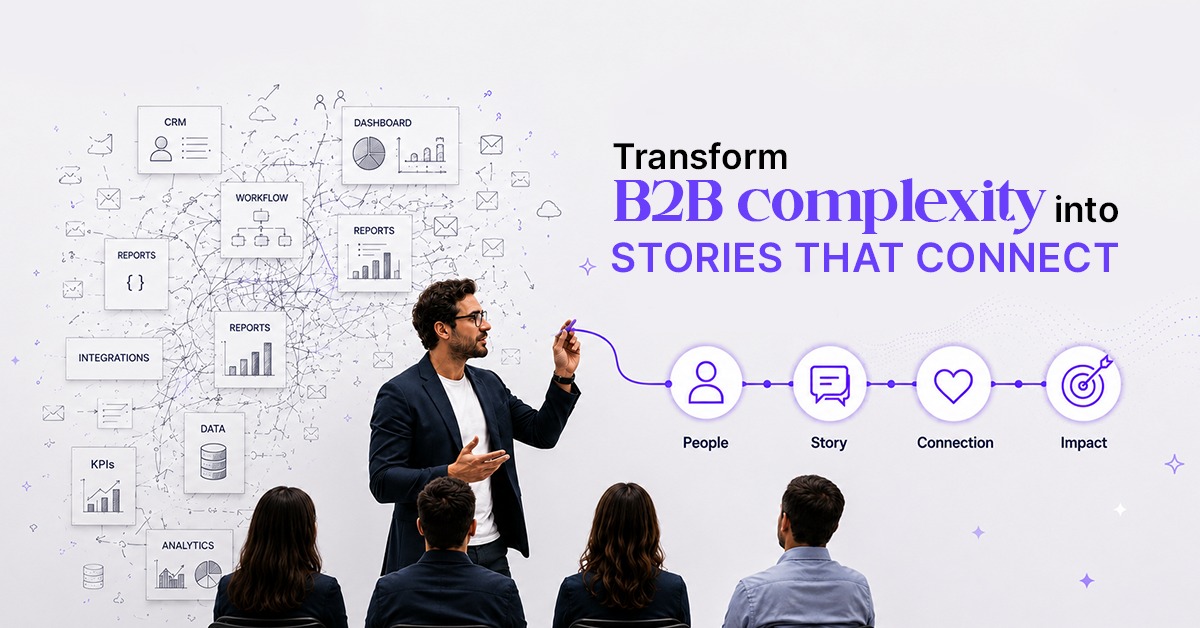
In a world full of ads, posts, emails, presentations, and endless digital noise, attention has become one of the hardest things for brands to earn. Every company is trying to explain what it does. Every brand is promising quality, innovation, experience, and results. But the truth is, people do not always remember the most technical message. They remember the message that made them feel something, understand something, or see themselves inside the story.
This is where storytelling becomes powerful. Today, storytelling is no longer only for lifestyle brands, emotional campaigns, or consumer products. It has become an essential part of B2B marketing. Because behind every business decision, there is still a human being trying to solve a problem, reduce pressure, avoid risk, prove value, and make the right choice.
Why Storytelling Matters More Than Ever
Modern audiences are exposed to thousands of messages every day. This makes traditional marketing harder to notice, especially when many companies sound the same. In B2B, brands often depend on features, services, and technical terms, but these alone are not enough to create interest or trust. Storytelling helps simplify complex ideas. It gives the audience a reason to care. Instead of saying, “We provide automation solutions,” a brand can show the daily pressure of employees losing hours on repetitive tasks. Instead of saying, “We offer cybersecurity services,” a brand can tell the story of one small vulnerability that could put an entire business at risk.
B2B Buyers Are Still Human
One of the biggest mistakes in B2B marketing is treating the audience as if they only think logically. Of course, B2B buyers care about numbers, efficiency, ROI, security, and performance. But they also care about confidence, reputation, pressure, and trust. A decision-maker may be asking: Will this solution make my team’s work easier? Will it reduce risk? Will it help me look prepared in front of management? Will this company understand our challenges? Storytelling answers these questions in a human way. It does not replace facts; it gives facts a stronger context.
The Power of Before and After
Every strong B2B story has a transformation. There is a situation before the solution and a better one after it. Before automation, teams may be stuck in manual tasks. After automation, they have more time for decisions that matter. Before a CRM system, customer information may be scattered across departments. After CRM, every team has one clear view of the customer. Before digital transformation, systems may be disconnected and slow. After it, operations become more connected, faster, and easier to manage. This structure is simple, but very effective.
Storytelling Builds Trust
In B2B, trust is everything. Companies do not choose partners only because they have a nice logo or a strong claim. They choose partners who understand their industry, their challenges, and their goals. Storytelling gives brands the chance to prove understanding. When a company describes a real problem in a clear and accurate way, the audience feels, “They understand it.” That moment is powerful. It creates credibility before the brand even explains the solution. A clear story makes the brand feel more experienced, more aware, and more connected to the customer’s reality.
Making Complex Services Easier to Understand
Many B2B services are difficult to explain in a simple post or short video. Technology, cybersecurity, cloud solutions, ERP, automation, and data services can easily sound complicated or too technical. Storytelling helps translate complexity into meaning. For example, instead of explaining every technical detail of a document management system, we can start with a familiar scene: employees searching through folders, waiting for approvals, and losing time because files are scattered everywhere. Then the solution appears naturally as the answer to that frustration. This makes the content clearer, more relatable, and more memorable.
Storytelling Does Not Mean Being Dramatic
B2B storytelling should not feel exaggerated or fake. It does not need emotional drama or poetic language. The strongest B2B stories are often simple, practical, and honest. A good B2B story can be built around a challenge, a process, a customer journey, a team’s daily struggle, or a company’s growth. The key is to make the message feel real. The goal is not to entertain only. The goal is to make the audience understand why the solution matters.
How Brands Can Use Storytelling Today
Brands can use storytelling across many formats: LinkedIn posts, case studies, short videos, website copy, presentations, carousels, and campaigns. A LinkedIn post can begin with a business problem. A video can show a team before and after using a solution. A carousel can walk the audience through a challenge step by step. A case study can become more than numbers by showing the journey behind the results. The best storytelling connects three things: the problem, the people affected by it, and the positive change created by the solution.
The Future Belongs to Brands That Tell Better Stories
As content becomes faster, shorter, and more crowded, brands need more than visibility. They need meaning. They need to communicate in a way that feels clear, human, and worth remembering. Storytelling gives B2B brands that advantage. It helps them move beyond “what we offer” and start communicating “why it matters.” It transforms services into solutions, features into value, and companies into trusted partners. In the end, B2B storytelling is not about making business less professional. It is about making business more understandable, more human, and more connected to the people making the decisions.
At IZDAHER, we help brands turn their message into stories that connect, inspire, and grow.
Let your brand story flourish with IZDAHER.

